

Become a for mobile professional sharpening with the 156 h course
Learn the trade of a sharpener and complete your training with 36 hours of modules dedicated to complementary skills for your future activity.
- Master the sharpening and grinding techniques
- Benefit from 36 hours of additional modules
- Develop skills to diversify your business

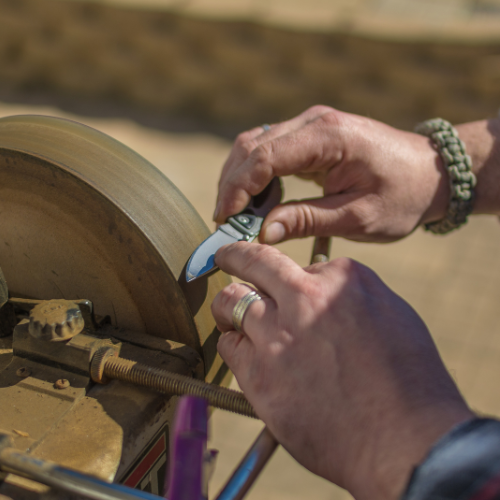
A complete course of 156 hours
Including 36 hours of additional modules
% 70 hours of practice on machines
At Escaudain (59)
RNCP certificationXXXXX
A complete course of 156 hours
The 156-hour training program builds on the 120-hour course dedicated to learning the trade of a mobile professional sharpener, with an additional 36 hours of complementary modules..
In this way, you will acquire the professional techniques and gestures of sharpening and re-bonding, while developing additional skills to prepare and diversify your future business.
The professional foundation (120 h)
- Security, tools and metals
- Professional sharpening equipment and techniques
- Sharpening of various cutting, sharp and perforating tools
- Hairdressing and grooming
- Organisation and development of a professional sharpening business
4 additional modules (36 h)
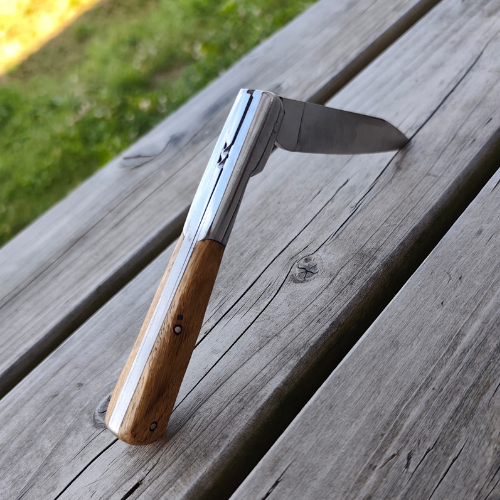
16 h · Assembly of knife kits
- Knives kits, models and components
- Materials, shaping and finishing of knife handles
- Knife assembly and customisation
- Presentation and sale of the works
4 h · Metal engraving by electrolysis
- Printers and generators
- Creation of photos and lettering
- Surface preparation and engraving
- Electrolytic etching
8 h · Manual Sharpening Stones & Honing Steels
- Sharpening stones, grit sizes and honing steels
- Choosing the right equipment for each knife
- Use with and without an angle guide
- Practical exercises
8 h · Setting Up a Mobile Sharpening Vehicle
- Essential concepts in electricity
- Safety and electrical circuits
- Vehicle insulation
- Vehicle layout according to equipment requirements
- Practical work: diagrams, assemblies, measurements, tests and diagnostics
This training is really very interesting and meets all the criteria I was looking for. It is intense but we learn a lot of practical things and it gives us all the keys to succeed as a professional sharpener.
Sébastien
Why choose the 156-hour course?
The 156-hour course is particularly designed for people who want to complement their training as professional sharpeners with additional skills they can use in their future business.
Expanding our expertise
Beyond sharpening and grinding techniques, you discover other practices: knife assembly, metal engraving, and sharpening using manual sharpening stones and honing steels.
Preparing for your itinerant activity
The module dedicated to vehicle layout provides the necessary foundations for planning and organising your future mobile workspace.
Diversifying your activities
The additional modules allow for additional services and features to be considered around the knife, its maintenance, and its customization.
Upon completion of the training, you will be able to…
Working as a mobile professional sharpener also means knowing how to develop and manage your business. This first block provides you with the necessary skills to structure your project, define your prices and investments, find your clients and sell your services. The goal: to have the foundations in place to transform your technical expertise into a real professional activity.
- Making choices related to his market research
- Implementing health and safety rules to organize your workplace
- Defining the prices to be charged for the equipment
- Designing a commercial strategy and a forecast budget
- Plan for the investments
- To carry out the advertising, commercial prospecting and the sale of its services or products
- Accompanying his clientele
- Advise your clients
- To specify the price of its or its services
- Present a clean, organized workplace that complies with safety regulations
See the RNCP profile

This is the core of the professional sharpener's trade. You learn to observe a tool, understand its wear and tear, and choose the appropriate technique, Before implementing the various sharpening techniques, the goal is not simply to reproduce a gesture, but to know how to adapt your work to each tool and situation.
- Apply the rules of hygiene and safety, particularly those related to the carrying and transport of category D weapons.
- Identify different tools, metals and types of wear: knives, woodworking, stoneworking and gardening tools, scissors, razors, hairdressing and grooming clippers, types of metal, clamping systems and cutting angles.
- Diagnose the wear or defects of a tool and choose the appropriate equipment, machine and technique.
- Master the various cutting-edge maintenance techniques: honing, sharpening, edge sharpening, grinding, deburring, hammering, lapping, micro-bevelling, hollow grinding, burnishing, work hardening, buffing, bright polishing, edge restoration and polishing.
- Using and maintaining sharpening equipment: leather, stones, abrasive belts, grinding wheels, adjustment devices, sharpening pastes and powders.
- Adapt the intervention technique to the type of tool, the defect and the wear encountered.
- Controlling and evaluating the quality of the work performed.
See the RNCP profile
The 36 additional hours of the 156-hour course allow you to expand your skills beyond the basic requirements of the profession and acquire complementary skills useful for your future career.
- Assemble and customise different knife models
- Performing engravings on metals by electrolysis, particularly photos and lettering; ;
- Choosing and using sharpening stones and honing steels suitable for maintaining and sharpening knives
- Maintain a consistent angle during manual sharpening, with or without an angle guide
- Understanding the basics of electrical installations for a mobile sharpening vehicle
- Prepare the layout of your vehicle according to your equipment and energy needs; ;
- Developing new service opportunities related to knives and their customisation
Have your training funded
The majority of our learners can benefit from a full or partial support for their training as mobile sharpener.
With your CPF
Our training is eligible for the CPF
With another device
For example: Transitions pro, France Travail, AGEFICE, etc…
Self-financing
Exchange about your financing
Do you want to know the financing options available for your training? Depending on your situation and your project, different solutions can be considered.
Contact the FCTV team to review your situation and explore the support options tailored to your training project.
Are you hesitating between the 120-hour course and the 156-hour course?
You want to train to become a mobile refiner but you don’t know which course best suits your project? Talk to the school team to discuss your needs and choose the most suitable training.
Course 120 hours
-
Professional sharpener training
-
Professional sharpening techniques
-
Development of activity
-
Knife Kit Assembly
-
Engraving on metals
-
Sharpening stones & honing steels
-
Vehicle configuration
Course 156 h
-
Professional sharpener training
-
Professional sharpening techniques
-
Development of activity
-
Knife Kit Assembly
-
Engraving on metals
-
Sharpening stones & honing steels
-
Vehicle configuration
Frequently asked questions
What is the difference between the 120-hour and 156-hour training programs?
The 156-hour training course builds on the 120-hour course and supplements it with 36 hours of additional training. These 36 hours are dedicated to assembling knife kits, engraving metals using electrolysis, using sharpening stones and honing steels, and fitting out a mobile sharpening vehicle.
Why choose the 156-hour training instead of the 120-hour one?
The 156-hour course allows you to train as a professional sharpener while developing complementary skills. It may be particularly suitable if you wish to prepare more broadly for your future career and diversify your skills from the outset of your training.
What are the four additional modules included in the 156 hours?
The 36 additional hours include 16 hours assembling knife kits, 4 hours engraving metals using electrolysis, 8 hours dedicated to sharpening stones and honing steels, and 8 hours dedicated to fitting out a mobile sharpening vehicle.
Can the additional modules of the 156-hour training be taken separately?
The four topics proposed in the additional 36 hours are also the subject of tailored training sessions. You can therefore receive specific training in assembling knife kits, engraving on metals, using sharpening stones and honing steels, or fitting out a mobile sharpening vehicle, according to your needs.
Does the 156-hour training course prepare you for a career as a professionnal mobile sharpener ?
Yes. In addition to the core training dedicated to the professional sharpening trade, the course also covers business development. The additional modules address practical aspects of setting up a future business, such as fitting out a mobile sharpening vehicle, as well as developing skills that can help broaden the range of services and products offered.